Over 100,000 tracks are uploaded to Spotify every single day. That number alone should stop you cold. As an independent musician or songwriter, you are not just competing with artists in your city or genre. You are competing with everyone, everywhere, all at once. Without a compelling artist portfolio, you become invisible before anyone even hears your music. This guide breaks down exactly why portfolios are non-negotiable in 2026, what to put in yours, and how a well-built portfolio can open doors to real collaborations, bookings, and press coverage that actually move your career forward.
Table of Contents
- The artist portfolio: Your essential digital handshake
- Core elements of an effective artist portfolio
- How portfolios amplify visibility and attract opportunities
- Common mistakes and overlooked nuances
- A creator's insight: Why up-to-date portfolios really matter
- Showcase your music with a professional portfolio
- Frequently asked questions
Key Takeaways
| Point | Details |
|---|---|
| Portfolios are must-haves | A well-built artist portfolio is essential for musicians to stand out and secure new opportunities. |
| Quality trumps quantity | Focusing on a few strong tracks and recent content is more effective than overwhelming detail. |
| Video drives results | Live and high-quality video content sharply boosts your visibility and booking chances. |
| Regular updates matter | Keep your portfolio current to reflect your best work and stay relevant in a fast-moving industry. |
The artist portfolio: Your essential digital handshake
An artist portfolio is more than a website. It is your professional identity in digital form. Think of it as a combination of a resume, a highlight reel, and a first impression all rolled into one. For musicians, this often takes the shape of an Electronic Press Kit, or EPK, which is a structured collection of your most important professional materials. Your bio, music samples, photos, press coverage, and contact details all live in one organized place.
An artist portfolio acts as a digital resume and central hub, giving industry contacts everything they need without making them search for it. That convenience matters more than most artists realize. A booking agent or music supervisor who has to dig through three different social media profiles to find your best track will simply move on to the next person.
"An effective EPK serves as a digital handshake and highlight reel, required for gigs, media coverage, and label interest."
The difference between artists who have portfolios and those who do not is stark. Here is a side-by-side look at what that gap looks like in practice:
| Situation | With a portfolio | Without a portfolio |
|---|---|---|
| A booker searches for you | Finds a professional, organized page | Finds scattered social posts or nothing |
| A collaborator reaches out | Has everything they need to say yes | Has to ask for materials, losing momentum |
| Press wants to cover you | Can pull bio, photos, and quotes instantly | Delays coverage or gets passed over |
| A sync opportunity arises | Portfolio signals readiness and credibility | Opportunity goes to a more prepared artist |
Professionalism is not just about talent. It is about showing people you take your craft seriously enough to present it properly. A portfolio does that without you having to say a word.
Core elements of an effective artist portfolio
Knowing you need a portfolio is one thing. Knowing what to put in it is another. A strong portfolio is not a dump of everything you have ever made. It is a curated, intentional presentation of your best work and most relevant information.
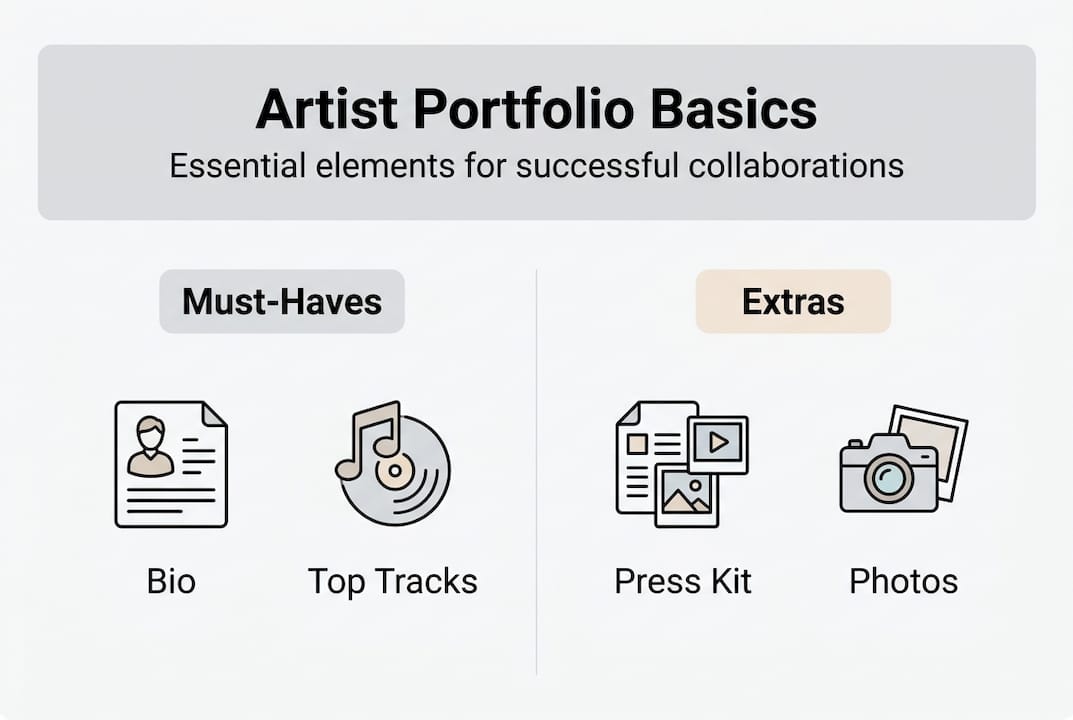
A complete EPK should include your bio, top tracks and videos, high-resolution photos, press coverage, touring history, streaming analytics, and clear contact information. It should also be SEO-optimized and mobile-friendly so it performs well in search and looks great on any device.
Here is a breakdown of required versus optional elements and what each one does for you:
| Element | Required or optional | Purpose |
|---|---|---|
| Artist bio | Required | Tells your story and builds connection |
| Top 2 to 4 tracks | Required | Demonstrates your sound immediately |
| High-res photos | Required | Supports press and visual branding |
| Press mentions | Required | Builds credibility and social proof |
| Streaming analytics | Required | Shows traction and audience engagement |
| Contact info | Required | Makes it easy for people to reach you |
| Music video | Optional | Adds depth and showcases stage presence |
| Tour history | Optional | Signals live performance experience |
| Testimonials | Optional | Reinforces trust from collaborators |
For hosting your portfolio, you have solid options depending on your budget and technical comfort level:
- Personal website builders: Squarespace, Wix, and WordPress give you full creative control
- Music-specific platforms: Sonicbids and ReverbNation are built for EPKs
- Hybrid approaches: A custom domain pointing to a well-organized site gives the most professional impression
Pro Tip: Resist the urge to include every track you have ever recorded. Two to four strong, polished songs will do more for you than a catalog of twenty average ones. Quality signals that you know your own strengths.
How portfolios amplify visibility and attract opportunities
A well-built portfolio does not just sit there looking nice. It actively works for you. Search engines reward organized, keyword-rich artist pages. When a music supervisor types a genre or mood into Google, a properly optimized portfolio can surface your name in results that a social media profile never would.
Visibility is only part of the equation. 70% of managers prefer seeing video work when evaluating an artist. That means if your portfolio lacks video content, you are already behind before the conversation starts. High-quality demos and live footage are not extras. They are expectations.
The data on live recordings is equally compelling. Including live performance recordings in your portfolio can boost booking opportunities by 30%. A studio track tells people how you sound in a controlled environment. A live recording tells them whether you can hold a room.
Here is a snapshot of the specific opportunities a strong portfolio can unlock:
- Gig bookings: Venues and festivals want to vet artists quickly; a portfolio makes that easy
- Press coverage: Journalists and bloggers need a bio and photos before they can write about you
- Sync licensing: Film and TV music supervisors search for artists with organized, accessible catalogs
- Brand collaborations: Companies looking for authentic voices want to see your story and audience
- Co-writing opportunities: Songwriters and producers look for artists whose aesthetic aligns with theirs
- Label or management interest: Industry professionals use portfolios to gauge professionalism before reaching out
Every one of these opportunities has a gatekeeper. Your portfolio is what gets you past them.
Common mistakes and overlooked nuances
Building a portfolio is not a one-time task you check off a list. Many artists put one together and then forget about it for years. That is one of the most damaging things you can do for your career momentum.
Here are the most common mistakes artists make with their portfolios:
- Outdated bios and photos: If your bio still references a project from three years ago or your headshots look nothing like you now, that sends a signal of neglect.
- Information overload: Packing in every project, every remix, and every collaboration you have ever touched overwhelms visitors and buries your best work.
- No tailoring for the audience: A portfolio sent to a festival booker should emphasize live performance. One sent to a music blog should lead with your story and press-ready assets. One size does not fit all.
- Ignoring analytics: Skipping your streaming or social numbers because they feel small is a missed opportunity. Framed correctly, even modest numbers tell a story.
- Broken links or missing contact info: Nothing kills a collaboration faster than a dead link or no clear way to reach you.
On the topic of numbers, keep it to 2 to 4 strong tracks, update regularly, tailor to your specific target, and frame lower metrics as an engaged community rather than a raw count.
Pro Tip: If your streaming numbers are modest, highlight engagement instead. A comment like "500 listeners with an average 80% song completion rate" tells a much more compelling story than just the follower count.
Set a reminder to review your portfolio every time you release new music, play a significant show, or receive press coverage. Keep it alive and it will keep working for you.
A creator's insight: Why up-to-date portfolios really matter
Here is something most advice skips over: the artists who get the most traction are not always the ones with the most impressive numbers. They are the ones who show up looking ready. A portfolio that was clearly updated last week signals hunger and professionalism in a way that a polished but stale page simply cannot.
There is a myth in the independent music world that you need major-label credentials or six-figure streaming numbers before an EPK is worth building. That thinking holds a lot of talented artists back. EPKs are essential for indie artists and act as proof of professionalism in a saturated market, regardless of where you are in your career.
Authenticity and recency beat impressive numbers for most collaborators. A songwriter who updates their portfolio with a raw new demo and a short note about what inspired it will often connect more deeply with a potential collaborator than an artist with a perfectly produced page that has not changed in two years. Your portfolio should feel like a living document, not a trophy case.
Showcase your music with a professional portfolio
You now have a clear picture of what a strong artist portfolio looks like and why it matters so much. The next step is putting that knowledge into action. Whether you are building your first portfolio or refreshing one that has been sitting untouched, the goal is the same: create a space that represents your artistry with honesty, clarity, and intention.
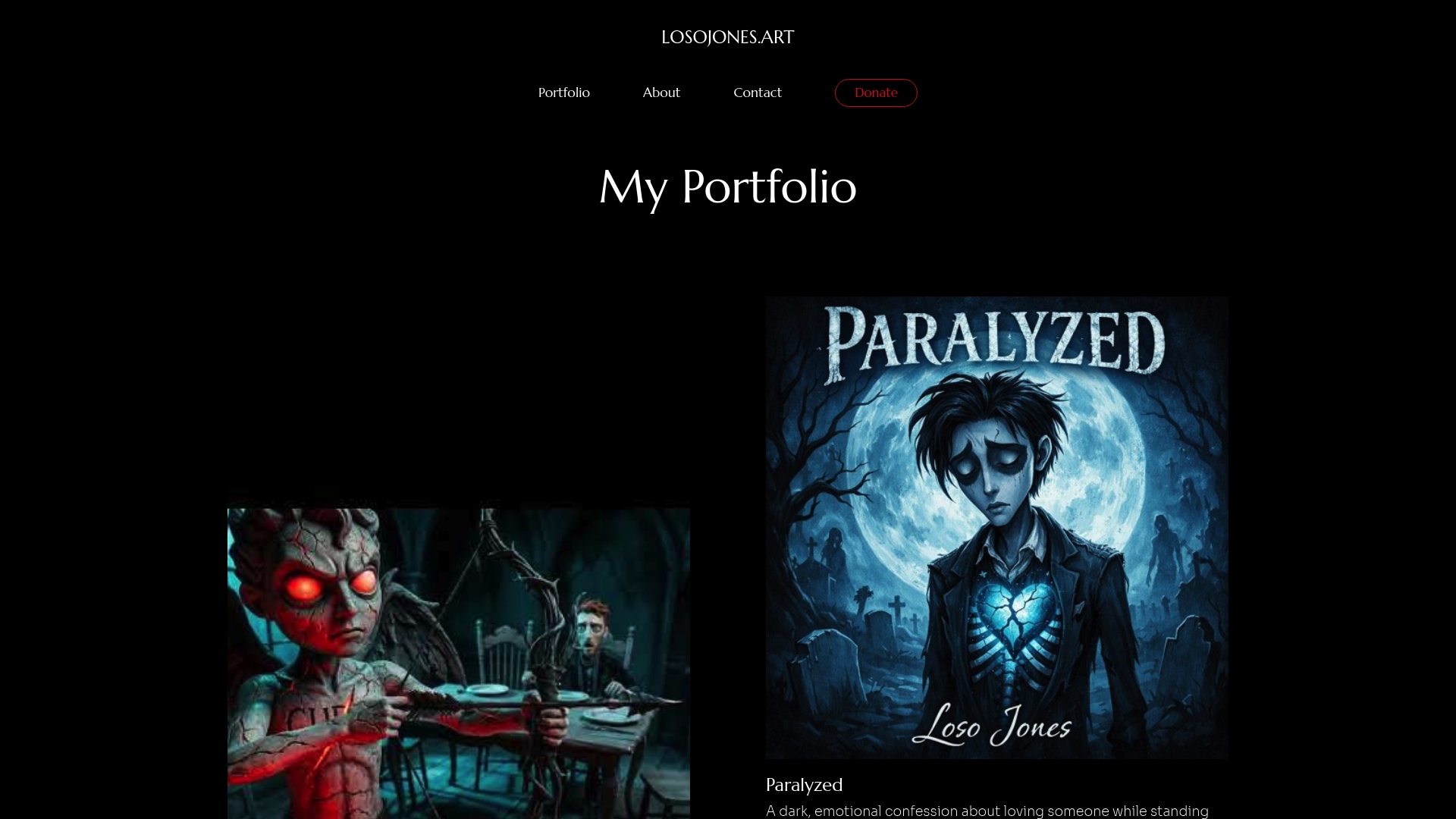
Loso Jones's portfolio example shows exactly how an independent songwriter can present their work in a way that feels personal, professional, and emotionally resonant. If you are ready to make your own mark, take a look and let it inspire you to create your artist portfolio with the same level of care and authenticity. Your next collaboration could be one click away.
Frequently asked questions
What should every artist portfolio include?
Every artist portfolio should include a bio, top music tracks or videos, high-quality photos, press mentions, touring history, key analytics, and contact info. These elements give industry contacts everything they need to make a decision quickly.
Do I need impressive streaming numbers to benefit from a portfolio?
No. You can frame a smaller but engaged audience as a strength, since quality engagement outweighs raw follower counts for most collaborators and bookers.
How often should I update my artist portfolio?
Update your portfolio every time you release new music, play more shows, or receive new press coverage. Regular updates ensure relevance and show industry contacts that you are actively building your career.
Why are video performances important in a portfolio?
Live video performances showcase your talent and stage presence in a way studio recordings cannot. 70% of industry professionals prefer seeing video work when evaluating an artist for opportunities.